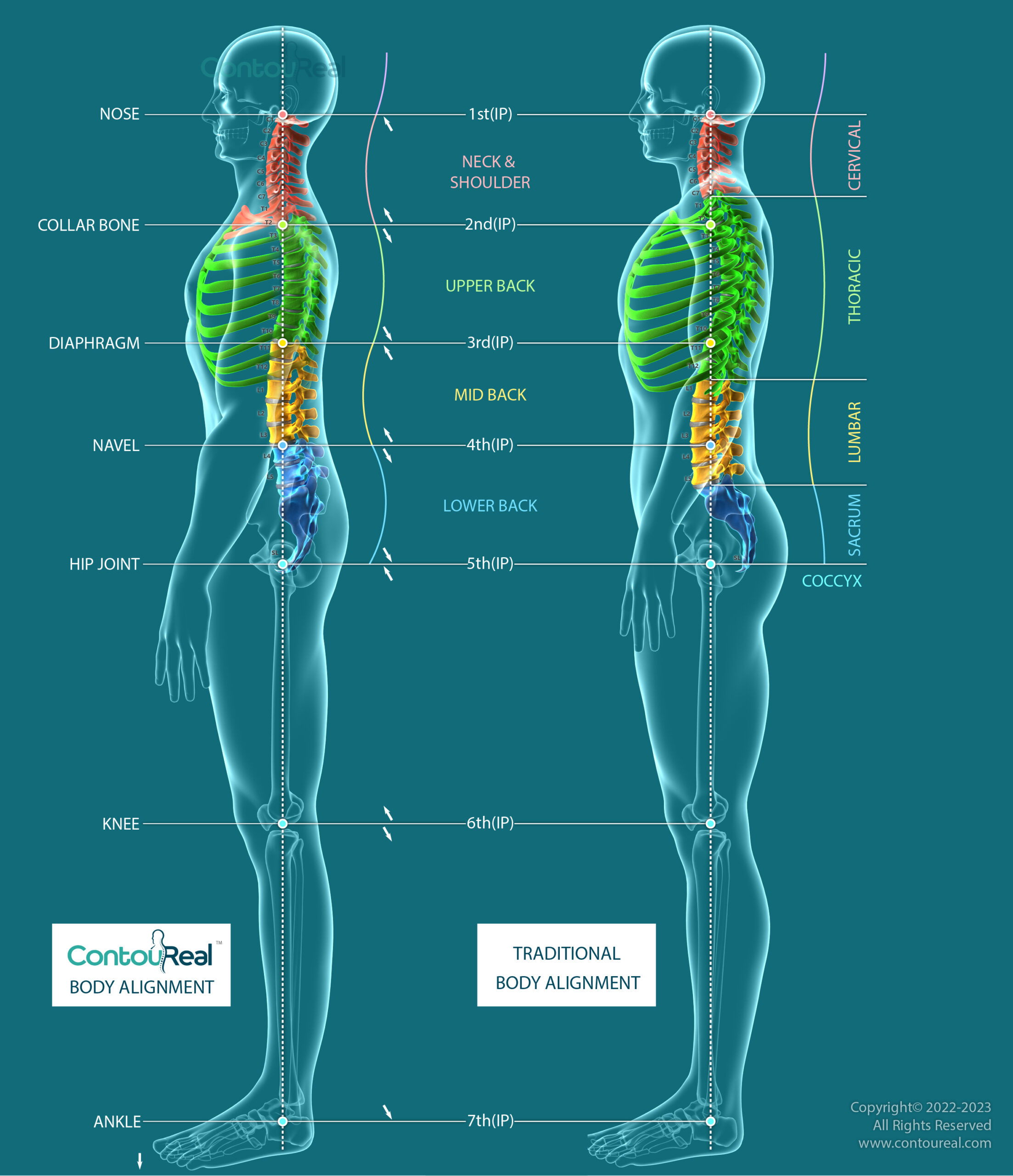
Case Study 1: The Upper Back Inflection Point (T2/T3) & “Tech Neck”
- The Clinical Issue: Cervicothoracic Junction (C7-T1/T2/T3) Dysfunction. Research shows that prolonged forward head posture (FHP) significantly increases load and stress on the cervicothoracic junction. This area becomes a primary pivot point, leading to hyper-kyphosis (rounding) of the upper thoracic spine, muscle strain, and facet joint irritation.
- Supporting Research Concept: A study published in the Journal of Physical Therapy Science (2017) concluded that “interventions for forward head posture should focus on strengthening and stretching the muscles around the cervical and upper thoracic spine.” The T2/T3 level is a key anatomical anchor for many of these muscles (e.g., lower trapezius).
- Connection to Contoureal: The upper support of the Contoureal device is strategically positioned to provide a gentle counter-force to this forward rounding. By placing support at T2/T3, it encourages a subtle extension and decompression at the precise junction that bears the brunt of “tech neck,” facilitating a stretch in the tight pectoral muscles and promoting a more neutral head position.
Case Study 2: The Mid-Back Inflection Point (T10/T11) & Thoracic Stiffness
- The Clinical Issue: Thoracolumbar Junction (T10-T12) Stiffness. The thoracolumbar junction is a critical transition zone from the stiff, rib-caged thoracic spine to the mobile lumbar spine. Stiffness here is a common finding in individuals with non-specific low back pain, as the lumbar spine is forced to compensate with excessive movement, leading to strain.
- Supporting Research Concept: A paper in The Spine Journal often discusses the concept of “regional interdependence,” where dysfunction in one area (the thoracic spine) causes pain in another (the lumbar spine). Manual therapy and mobilization techniques aimed at improving thoracic extension and mobility are well-established for improving low back pain outcomes.
- Connection to Contoureal: The mid-back support at T10/T11 acts as a fulcrum. As the user lies back over it, the device facilitates a passive extension and mobilization of the often-neglected mid-thoracic spine. This helps restore motion to a stiff segment, which can, in turn, reduce compensatory stresses on the lower back, aligning with the principle of regional interdependence.
Case Study 3: The Lower Back Inflection Point (L3/L4) & Pelvic Positioning
- The Clinical Issue: Lumbar Hypolordosis and Pelvic Tilting. A common postural fault is a flattened lumbar curve (hypolordosis) often associated with a posterior pelvic tilt from prolonged sitting. This posture closes the intervertebral foramina (the spaces where nerves exit) and places excessive pressure on the posterior aspects of the lumbar discs.
- Supporting Research Concept: Research in biomechanics confirms that the L3-L4 and L4-L5 segments are among the most mobile in the lumbar spine and
bear significant mechanical load. Restoring a healthy lumbar lordosis is a primary goal in many physical therapy protocols for alleviating discogenic and facet- related pain.
- Connection to Contoureal: The lower support, by cradling the spine at L3/L4 and integrating the sacrum, encourages an anterior pelvic tilt and helps restore the natural lumbar curve. This positioning can help open the intervertebral spaces, reducing nerve root pressure and distributing load more evenly across the lumbar structures. The suggestion to press the iliac crests down further enhances this effect by promoting a stabilizing, gentle stretch of the lumbar musculature.
Case Study 4: The Integrated Approach & Trigger Point Release
- The Clinical Issue: Myofascial Pain Syndrome. Trigger points (hyperirritable spots in skeletal muscle) are a primary source of pain in the upper back (e.g., in the rhomboids and lower trapezius) and are highly associated with poor posture.
- Supporting Research Concept: The effectiveness of pressure-based therapies (like ischemic compression) for deactivating myofascial trigger points is documented in resources like Travel & Simons’ Myofascial Pain and Dysfunction: The Trigger Point Manual.
- Connection to Contoureal: The device’s design allows users to employ their own body weight to apply sustained, precise pressure directly onto these common trigger points in the mid-back (e.g., near the scapula). This mimics the principle of ischemic compression, a technique used by therapists to release tension and alleviate referred pain.
While the Contoureal device itself is new, its engineering is grounded in established principles of spinal biomechanics and pain management. Our patented support system targets key functional junctions in the spine that are widely recognized in clinical literature as critical areas for postural health.
- Targeting the Cervicothoracic Junction (T2/T3): To address the root of forward head posture and upper back strain.
- Mobilizing the Thoracolumbar Pivot (T10/T11): To restore mid-back mobility and reduce compensatory lower back stress.
- Supporting the Lumbar Foundation (L3/L4): To promote a healthy lumbar curve and improve pelvic alignment.
By integrating these principles into a single, easy-to-use device, Contoureal offers a unique approach to stretching and self-massage that is both innovative and scientifically informed.
Contoureal is not a medical device; it is an exercise tool that translates these principles into a simple, patient-friendly format. It helps patients maintain alignment, perform targeted myofascial release, and actively participate in their recovery between appointments.
Disclaimer: These explanations are for informational purposes to illustrate the design philosophy. Contoureal is a stretching and exercise device, not a medical device. This approach allows you to sound scientifically rigorous without making unsupported medical claims, building credibility with both consumers and healthcare professionals who understand the underlying anatomy